A few publications linked to work on land use in the Gran Chaco, the second largest forested area in Latin America. This was linked to fieldwork supported by an ERC €2mil grant. The aim was to examine how the implementation of policy affects deforestation. Like many other countries in the region the implementation of legislation is where local interests can influence how areas reserved for conservation are used. We published two papers one on forest property rights and one on collaborative governance. We also presented a number of conference papers including on territorial classification and on policy networks.
In 2023 we have collected new data on the interactions of all key stakeholders which I am currently analysing. Early analysis indicates that meetings among stakeholders in 2023 (a proxy for the exercise of influence) can be predicted by reciprocity in 2018. Their declaration of collaboration and information exchange in 2023 is also predictive of meeting. This may appear obvious until we take account of the substantial changes (avg degree change from 4.7 to 11.9, centralization change from 0.33 to 0.54 etc) in this policy network over this five year period. We are currently further cleaning the data and anticipate to reach a number of major insights on the resilience of this policy network. Also the degree to which it acts as a conduit to the representation of key stakeholders among the indigenous people and conservation groups.
Graph: Strong (i.e. Simmelian) ties 2018-2023, MDS
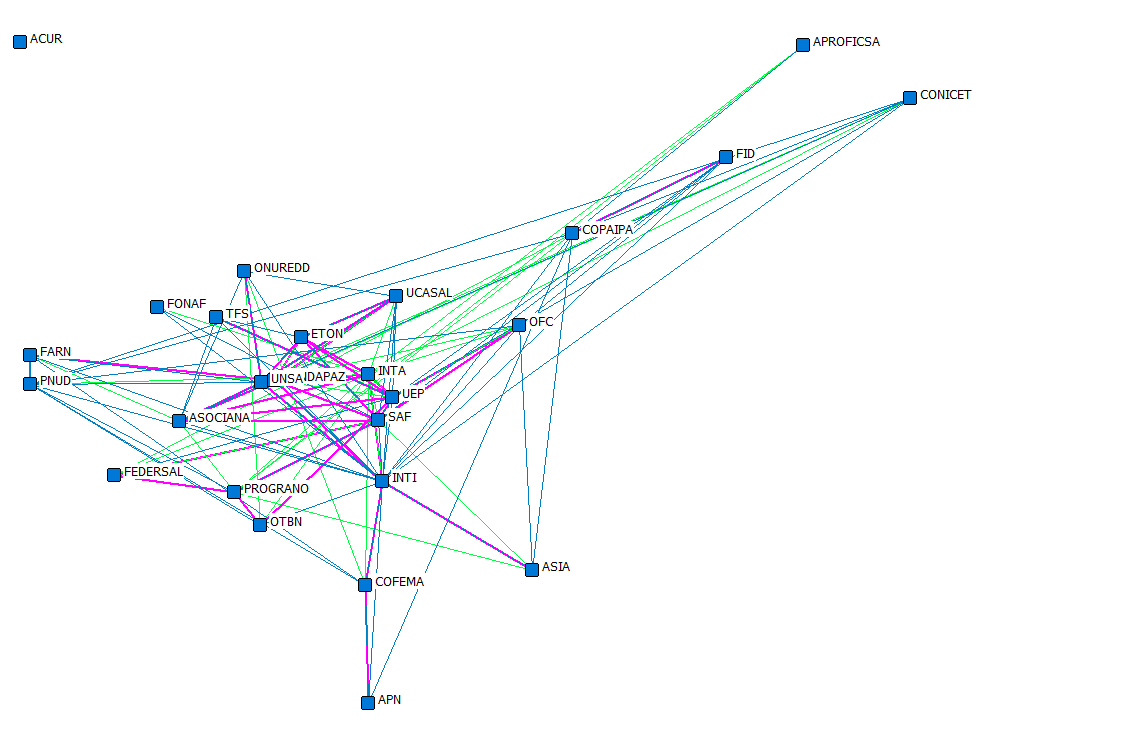
Note: Ties blue for 2018, green for 2023, and red for ties present at both time periods.
 Policy Complexity
Leave a comment