Work on how research funding fosters collaboration in the UK has looked across collaborations in projects by the four main UK public funding bodies (abstract below). We find that awarded projects reflect different patterns of collaboration in the humanities and social sciences from engineering and biological sciences. This has significant implications for the way teams form and research projects are delivered. We also find that distance matters in research collaborations and that some regions (like SE England) have an agglomeration advantage. Elite universities (the UK Russel Group) were more central, they exhibit more activity and that this was particularly pronounced among the “hard” sciences.
Future research involves exploring the multiplexity and multimodality of these networks, across the periodic assessment of research in the UK (REF cycles or QS rankings) to consider whether collaborations and success in research funding reflect in improved performance.
Currently also under review is work on collaboration in decarbonization research in which we compare UK (UKRI) and European funding (Horizon 2020). The role of the triple helix in the production of innovation (University-Industry-Government) appears to manifest differently across jurisdictions, while the network position of countries in these collaborations does not reflect the dependence on key pollutants (i.e. coal). Further work pending. Linked to funding from IDRIC Project 9.3 on Knowledge Transfer and Innovation Diffusion.
Graph: Core-periphery vs clustered collaboration networks: Engineering (EPSRC) vs Biological Sciences (BBSRC), (Smith, Sarabi & Christopoulos, 2023)
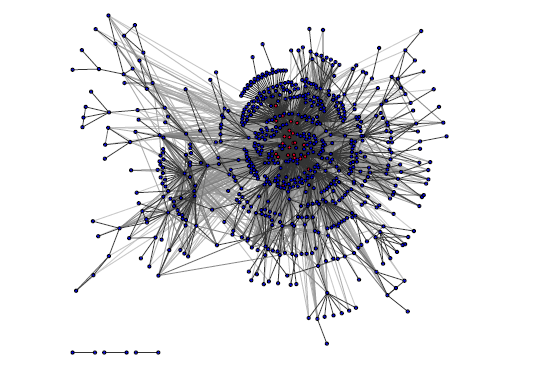
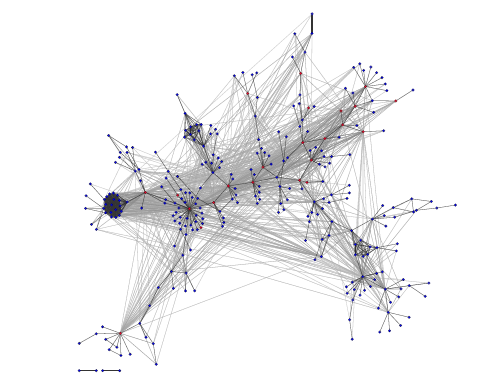
Understanding collaboration patterns on funded research projects: A network analysis; Matthew Smith;
Yasaman Sarabi; Dimitris Christopoulos
Network Science , Volume 11 , Special Issue 1: Scientific Networks , March 2023 , pp. 143 – 173
DOI: https://doi.org/10.1017/nws.2022.33
Abstract
This paper provides an examination of inter-organizational collaboration in the UK research system. Data are collected on organizational collaboration on projects funded by four key UK research councils: Arts and Humanities Research Council, Economic and Social Research Council, Engineering and Physical Sciences Research Council, and Biotechnology and Biological Sciences Research Council. The organizational partnerships include both academic and nonacademic institutions. A collaboration network is created for each research council, and an exponential random graph model is applied to inform on the mechanisms underpinning collaborative tie formation on research council-funded projects. We find that in the sciences, collaborative patterns are much more hierarchical and concentrated in a small handful of actors compared to the social sciences and humanities projects. Institutions that are members of the elite Russell Group (a set of 24 high-ranking UK universities) are much more likely to be involved in collaborations across research councils.
 Policy Complexity
Leave a comment